Home
>
Products > Touch Screen > 12.1 Inch G+G Capacitive Touch Panel with 1.8mm Cover Glass - CTP-VX121B5563-GG
Products

12.1 Inch G+G Capacitive Touch Panel with 1.8mm Cover Glass - CTP-VX121B5563-GG
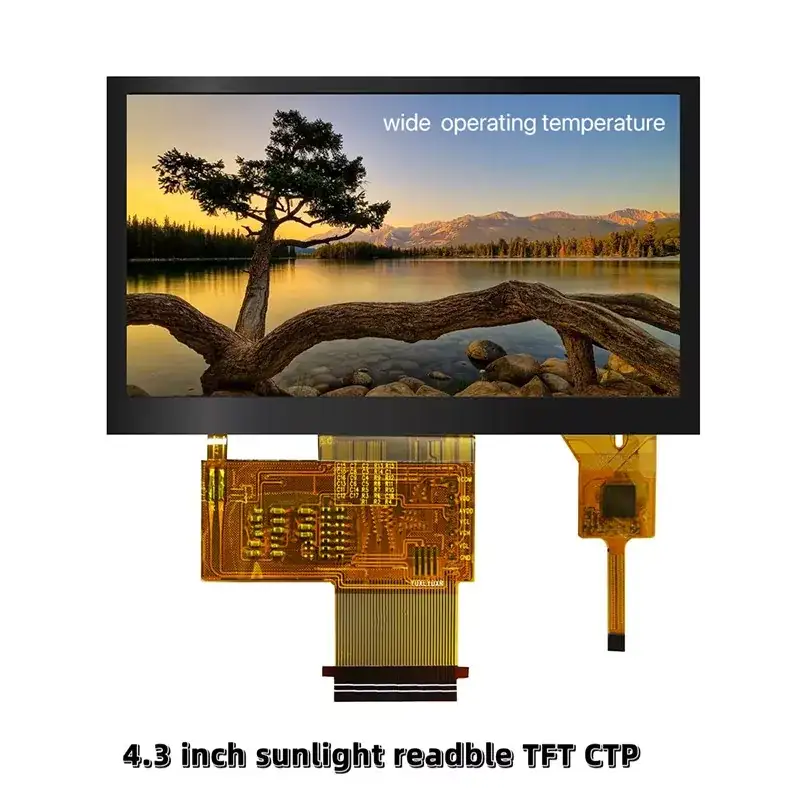
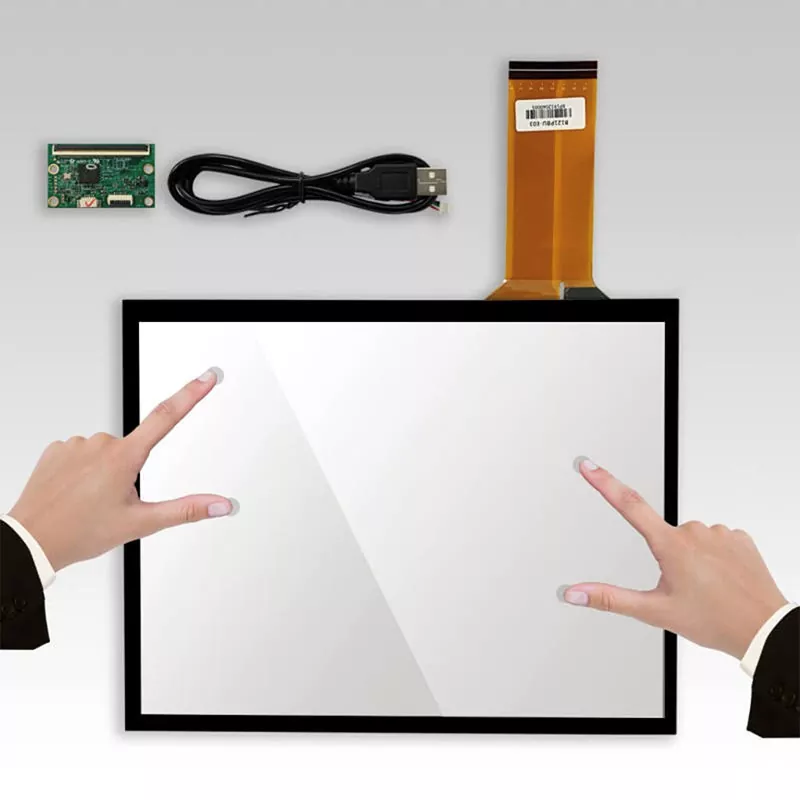
The CTP-VX121B5563-GG is a 12.1-inch capacitive touch panel in G+G construction with a 1.8 mm cover glass — the thickest in our range, about 1.6 times the usual 1.1 mm — bonded to the sensor with 0.2 mm SCA rather than a foam gasket. That combination is built for unattended and high-abuse installations. Transmittance is at least 85% with ≥6H hardness, and the total stack is 2.7 mm. Suited to industrial HMI, outdoor kiosks, transport terminals and medical equipment.
Model:CTP-VX121B5563
Send Inquiry PDF DownLoad
Product Description
1.8 mm Cover Glass: Specified for Abuse
Cover-glass thickness is the single most direct lever on how much punishment a touch screen survives, and it is usually the first thing value-engineered away. Standard panels ship at 0.7 to 1.1 mm. This one is specified at 1.8 mm.
|
Cover glass |
Relative thickness |
Typically specified for |
|
0.55–0.70 mm |
Baseline |
Consumer and light commercial, supervised indoor use |
|
0.95–1.1 mm |
Up to 2× |
Commercial kiosks, POS, general indoor terminals |
|
1.8 mm (this panel) |
approx. 1.6× the 1.1 mm class |
Unattended public terminals, industrial floors, transport, vandal-prone sites |
What the extra thickness actually buys. Glass resists impact roughly in proportion to its stiffness, and stiffness rises steeply with thickness, so a 1.8 mm lens tolerates far more energy before cracking than a 1.1 mm one. It also deflects less when pressed hard, which protects the sensor underneath from someone leaning on the screen or jabbing it with a tool. And because the surface is thick, it can be re-polished after light scratching rather than replaced — a genuine consideration for equipment with a ten-year service life.
The honest trade-offs. It adds weight, it adds about 0.7 mm of stack height over a 1.1 mm lens, and it costs more. For a supervised indoor terminal that nobody will ever strike, that is money spent for nothing, and a thinner panel is the better buy. This thickness is specified for a reason, and the reason is the installation.
SCA Lamination: No Air Gap
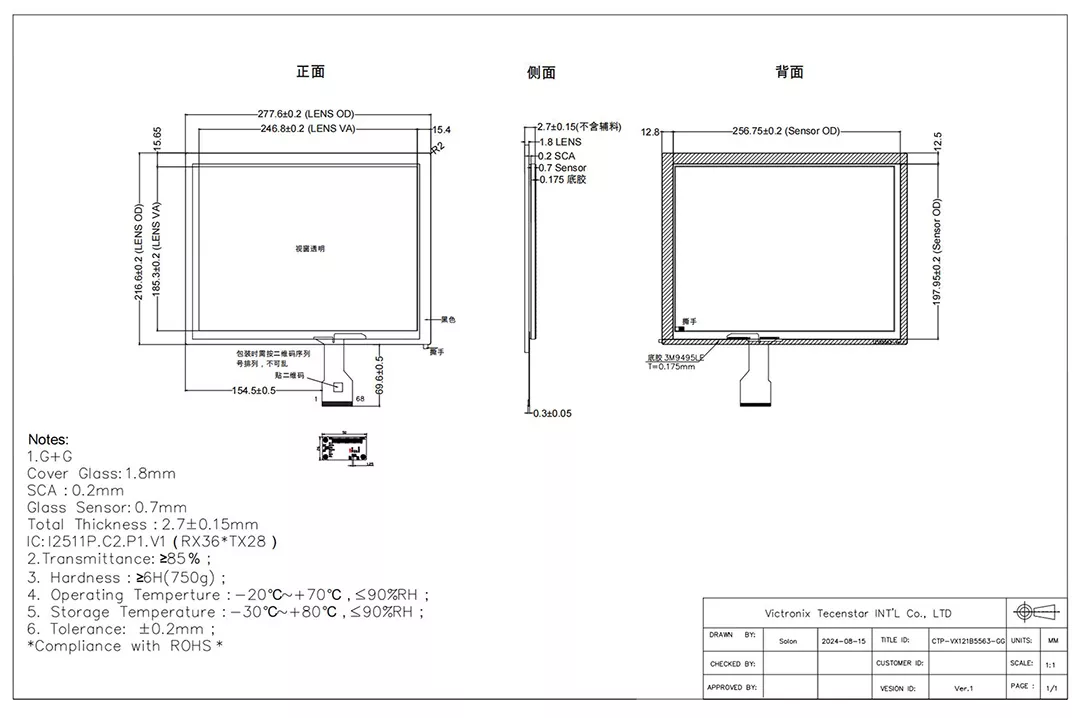
The second line worth reading on the drawing is the bonding layer: SCA 0.2 mm. SCA — solid clear adhesive — is an optically clear film used to laminate the cover glass to the sensor, as opposed to a foam gasket that leaves an air gap around the edges.
Removing the air gap changes four things, all in the same direction:
- Less internal reflection. An air gap creates two extra reflective surfaces. In a bright room or near a window, the reflection you see in a black screen is largely that gap. Laminating removes it, so the image looks markedly better under high ambient light.
- No internal fogging. Air gaps breathe. A panel that cycles between a cold night and a warm day can draw moist air in and condense on the inside of the cover glass, which looks exactly like a failed panel. A laminated stack has no cavity to condense in — the single biggest reliability win in outdoor and semi-outdoor installations.
- More rigid, so more impact-resistant. Laminated layers move as one, so an impact is spread rather than concentrated. This is why the 1.8 mm glass and the lamination are specified together.
- Better touch consistency. A rigid stack holds its geometry, so sensor calibration stays valid rather than drifting with temperature and flexing.
The trade-off, stated plainly: lamination is permanent. If the cover glass cracks, the whole assembly is replaced rather than the glass alone, and rework is harder than with a gasketed stack. That is an acceptable cost for equipment designed to survive abuse, and the wrong choice if you need field-serviceable glass — so tell us which you need and we will specify accordingly.
General Information
|
Item |
Value |
|
Model |
CTP-VX121B5563-GG |
|
Product Type |
Capacitive touch panel |
|
Size |
12.1inch |
|
Structure |
G+G (glass cover lens on glass sensor) |
|
Cover Glass Thickness |
1.8 mm — thickest in range |
|
Adhesive Layer |
SCA 0.2 mm — full lamination, no air gap |
|
Glass Sensor Thickness |
0.7 mm |
|
Total Thickness |
2.7 ±0.15 mm |
|
Touch Controller IC |
I2511P.C2.P1.V1 |
|
Channel Configuration |
RX36 × TX28 — approx. 1,008 nodes |
|
Estimated Channel Pitch |
approx. 6.6–6.8 mm — calculated, confirm |
|
Transmittance |
≥85% |
|
Surface Hardness |
≥6H at 750 g |
|
Operating Temperature |
-20°C to +70°C, ≤90% RH |
|
Storage Temperature |
-30°C to +80°C, ≤90% RH |
Outline Drawing
Hot Tags: 12.1 inch touch panel, capacitive touch panel, G+G touch screen panel, 12.1 inch touch screen overlay, projected capacitive touch panel, vandal resistant touch panel, thick cover glass touch panel, touch panel for industrial HMI, optically bonded touch panel, Victronix capacitive touch panel
Product Tag
12.1 inch capacitive touch panel
12.1 inch touch screen overlay
G+G structure capacitive touch screen
projected capacitive touch panel 12.1 inch
thick cover glass touch panel 1.8mm
vandal resistant capacitive touch panel
optically bonded touch panel no air gap
touch panel for industrial HMI panel
touch panel for outdoor kiosk
12.1 inch touch panel for control panel
Related Category
Send Inquiry
Please feel free to give your inquiry in the form below. We will reply you in 24 hours.
Related Products