Home
>
Products > Monochrome LCD Modules > Custom Segment LCD Display Module 600 cd/m² Low Power Backlight - VX50431-TY036LA
Products


Custom Segment LCD Display Module 600 cd/m² Low Power Backlight - VX50431-TY036LA
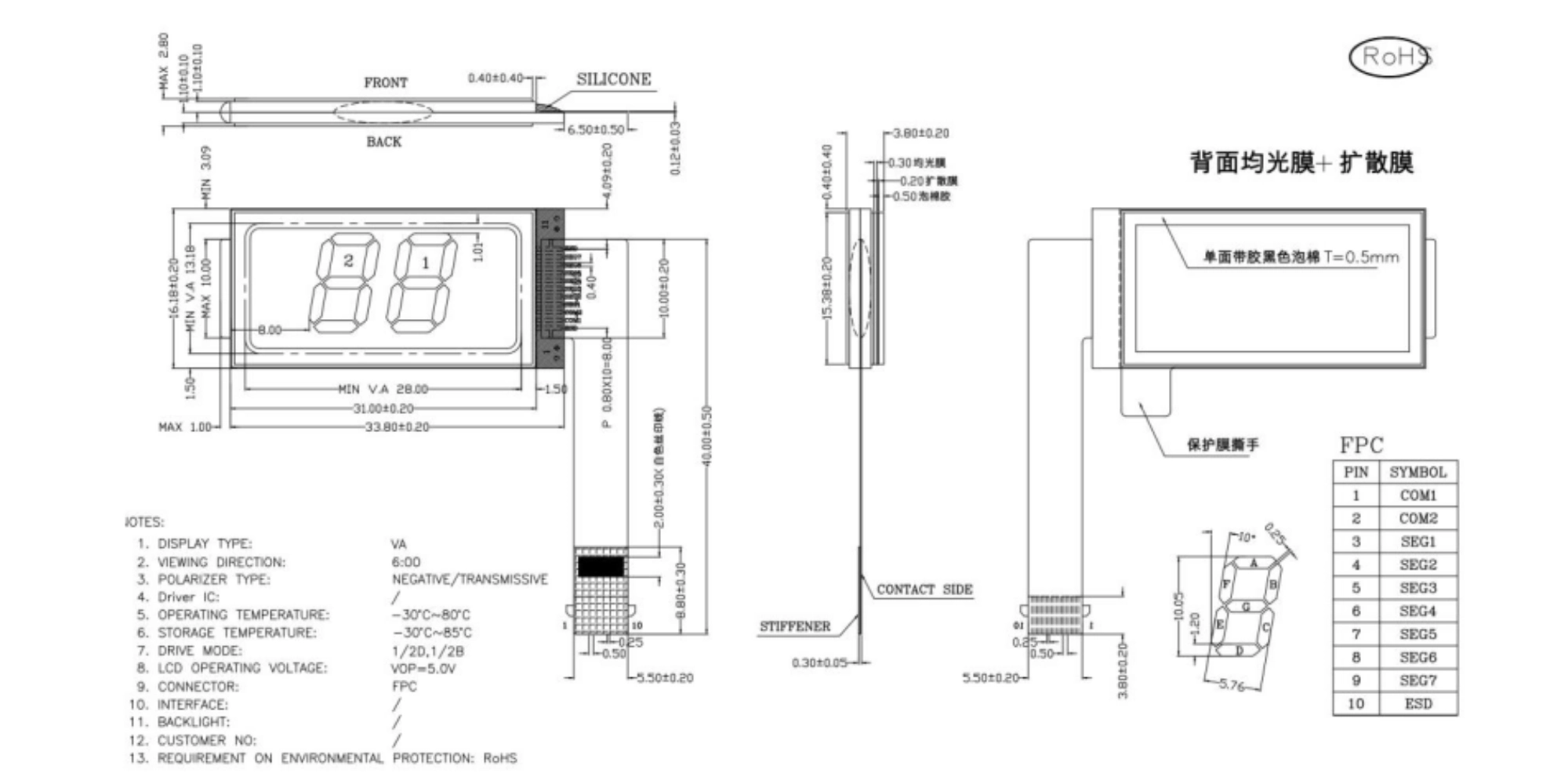
The VX50431-TY036LA is a custom VA type segment LCD display module for products that do not need a TFT. Its white LED backlight runs at 3.0 V and 60 mA — about 0.18 W, four to ten times less than the backlights in our TFT modules — so it runs from a logic rail or a single cell with no boost converter. Brightness is 600 cd/m² with 10:1 contrast. Rated -20 to +70°C and thermal-shock tested to -40 and +85°C.
Model:VX50431-TY036LA
Send Inquiry PDF DownLoad
Product Description
Not Every Product Needs a TFT
A TFT module is the default choice for a lot of projects, often by reflex rather than decision. It is worth checking, because for a large class of products a segment display does the job better and costs less doing it.
|
Factor |
Segment LCD (this module) |
TFT module |
|
Backlight power |
0.18 W |
0.72 to 1.84 W or more |
|
What it shows |
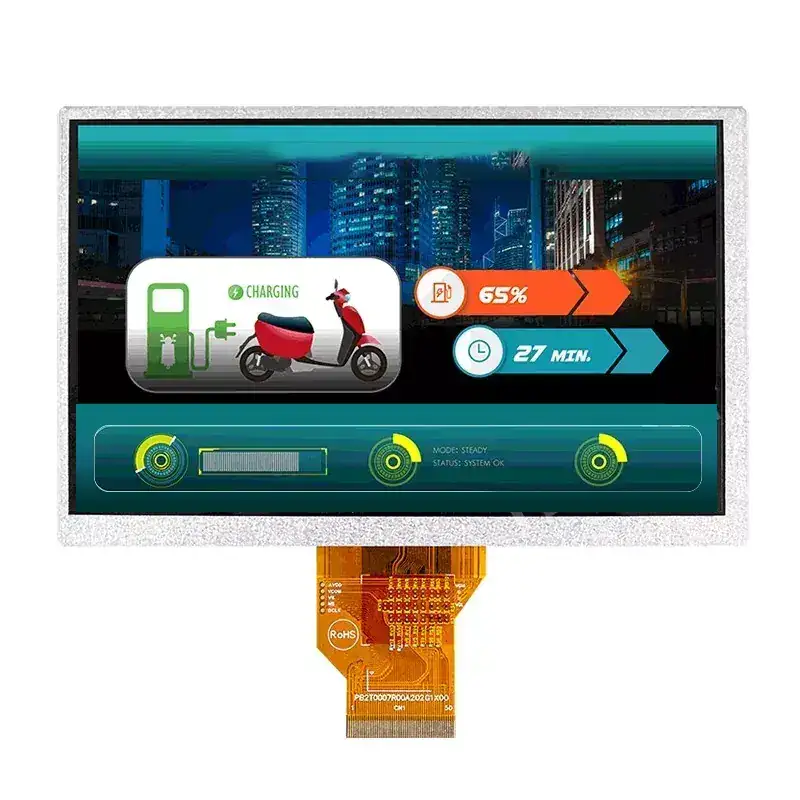
Fixed segments, digits, icons, bar graphs |
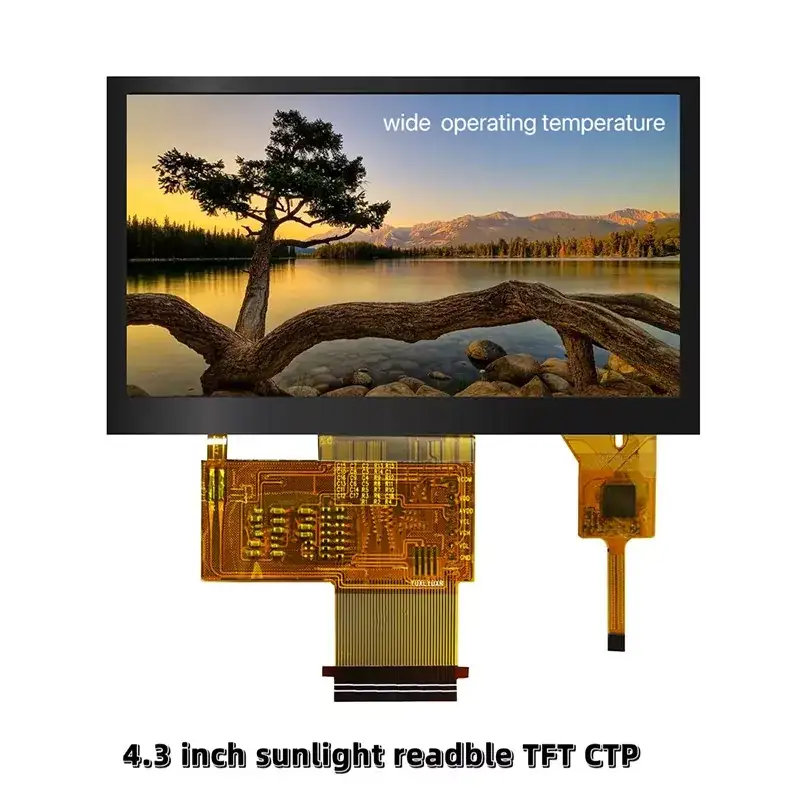
Any image, graphics, video |
|
Host interface |
A handful of pins, simple driver or none |
24-bit RGB or LVDS, timing, a frame buffer |
|
Controller load |
Minimal — often driven straight from the MCU |
Needs an LCD controller and external memory |
|
In daylight |
A reflective or transflective build reads without backlight at all |
Requires high brightness and still struggles |
|
Tooling |
One-off glass artwork, then very low unit cost |
Standard panel, no tooling |
|
Colour |
Monochrome |
Full colour |
|
Right for |
Meters, appliances, instruments, thermostats, gauges |
Graphical UI, images, video, dense data |
The decision is usually made by a single question: does the content change shape? If your display shows the same digits, icons and bar graphs for the life of the product, the segments can be drawn into the glass once and you are not paying for pixels you never use. If the content changes layout, needs images, or you expect to revise the interface after launch, a TFT is the correct answer and a segment display is the wrong one.
What you give up is flexibility. What you get back is power, cost, legibility in sunlight and a far simpler interface. For a battery instrument or a high-volume appliance, that is usually the right trade.
80 ms Response: Where It Matters and Where It Does Not
Response time is 80 ms rising and 30 ms falling. Against a TFT, which is typically 14 to 30 ms, that is slow. It is worth being honest about where that shows.
- It does not matter for what segment displays mostly do — digits, units, status icons and bar graphs that change a few times a second at most. At 80 ms a value update looks instantaneous to a person.
- It does matter if you intend to animate anything, multiplex at high speed, or chase a fast-changing numerical readout. A rapidly counting meter will smear at this speed.
For a thermostat, a utility meter, an appliance cycle indicator or a gauge, 80 ms is invisible. If you want a spinning icon or a live waveform, this is the wrong technology and you should be looking at a TFT instead.
General Information
|
Item |
Value |
|
Model |
VX50431-TY036LA |
|
Display Type |
Segment LCD (monochrome, custom glass) |
|
Backlight |
White LED |
|
Backlight power |
approximately 0.18 W |
|
Brightness |
600 cd/m² typical — confirm which measurement |
|
Contrast ratio |
10:1 typical |
|
Luminance uniformity |
70% minimum, 80% typical |
|
Viewing angle |
45° at 180°, 40° at 90° and 270°, 25° at 0° |
|
Response time |
80 ms rise, 30 ms fall |
|
Operating temperature |
-20°C to +70°C |
|
Storage temperature |
-30°C to +80°C |
|
Thermal shock |
-40°C to +85°C, 30 min each, 10 cycles |
|
Humidity |
60°C, 90% RH, 96 hours |
|
Vibration |
10–55 Hz, 1.5 mm, 30 minutes per axis, X–Y–Z |

Hot Tags: VA Segment LCD Module, segment LCD display, custom segment LCD module, segment LCD display module, monochrome segment LCD display, low power LCD display module, custom LCD display manufacturer, segment display for instruments and meters, segment LCD for industrial control panel, custom segment LCD glass display, Victronix segment LCD
Product Tag
segment LCD display module
custom segment LCD display
segment LCD display manufacturer
monochrome segment LCD display
low power segment LCD display
custom LCD display for instruments
segment display for meter and gauge
segment LCD for appliance control panel
custom segment LCD glass display
segment LCD with LED backlight
Related Category
Send Inquiry
Please feel free to give your inquiry in the form below. We will reply you in 24 hours.
Related Products